
Once Human PC Requirements: Minimum, Recommended, and 60 FPS Specs in 2026
Once Human's PC requirements still deliver accessible survival gaming in 2026, with minimum specs supporting decade-old hardware.
Once Human, the open-world survival game from Starry Studio, has maintained a steady player base since its release on July 9, 2024. Two years into its lifecycle, the PC requirements first shared before launch remain an interesting benchmark for understanding the game's accessibility. The developers originally published a three-tier specification list — covering minimum, recommended, and "ultra" 60 FPS configurations — and those numbers still hold up remarkably well in 2026. While game updates have introduced new content, the core engine optimization has kept the barrier to entry low, welcoming gamers with aging hardware alongside those running cutting-edge rigs.
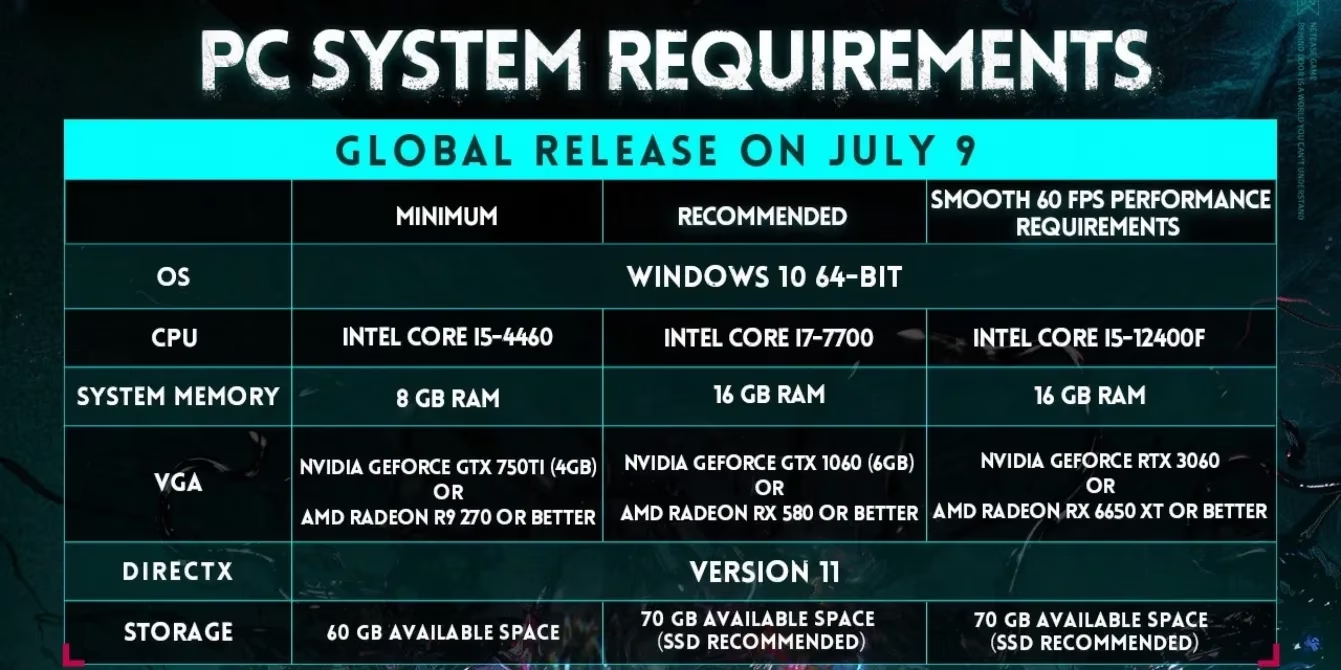
The minimum specifications reveal just how forgiving Once Human can be. To run the game at its baseline, one needs an Intel Core i5-4460 processor, an Nvidia GeForce GTX 750 Ti or an AMD Radeon R9 270 graphics card, 60 GB of free storage space, and a 64-bit installation of Windows 10 with DirectX 11. These components, first introduced back in 2013–2014, were already considered entry-level by the time the game launched. In 2026, a PC meeting these requirements could easily be a decade-old office machine or a handed-down gaming desktop. The fact that Once Human still boots and delivers a playable experience on such hardware is a testament to thoughtful scalability. Of course, visual quality and frame times will be modest — players should expect low to medium presets and resolutions around 1080p with some dips — but the core survival loop remains intact.

Moving to the recommended settings, the game asks for a noticeable but reasonable step up. An Intel Core i7-7700 CPU, 16 GB of system RAM, and either an Nvidia GeForce GTX 1060 (6 GB VRAM variant) or an AMD Radeon RX 580 are what the developers deemed ideal for a smooth and consistent experience. This setup typically targets 1080p at high settings, maintaining around 60 FPS in most scenarios. Storage recommendations rise to 70 GB, and an SSD becomes strongly preferred — not mandatory, but highly recommended to reduce texture streaming stutters and shave tens of seconds off loading screens. In 2026, these parts are still widely used: the GTX 1060 remains one of the most popular graphics cards on Steam hardware surveys, and the i7-7700 is a competent quad-core chip for budget gaming. Indeed, many players who built their PCs in 2017–2018 will find themselves perfectly equipped for Once Human without any upgrades. The game’s reliance on DirectX 11 rather than the newer DirectX 12 also broadens compatibility with older graphics drivers and operating system configurations, sidestepping the occasional instability that some DX12 titles exhibit on aging hardware.
For enthusiasts chasing a locked 60 FPS at the highest visual presets, the developers published an "ultra performance" specification. This tier calls for an Intel Core i5-12400F CPU, 16 GB of RAM, and either an Nvidia GeForce RTX 3060 or an AMD Radeon RX 6650 XT — or any faster alternative. Once again, 70 GB of free SSD space is listed as a necessity. The jump from the recommended GTX 1060 to an RTX 3060 or RX 6650 XT is substantial, reflecting the increased shader and post-processing demands of maximum draw distances, high-resolution shadows, and particle-heavy combat. Pairing a modern six-core CPU like the i5-12400F with a mid-range 1080p/1440p-capable GPU ensures that even chaotic multiplayer moments — with dozens of anomalies, miniguns blazing, and base-building constructs on screen — stay fluid. The recommendation of the RTX 3060 also hints at the benefits of technologies like DLSS, which Once Human can leverage on Nvidia cards to boost frame rates without sacrificing visual clarity. Even in 2026, this tier requires hardware that is affordable and widely available in the pre-built and second-hand markets, meaning that achieving a premium experience doesn’t demand the latest $1,000 graphics card.

Looking at the whole picture, Once Human's PC requirements illustrate a deliberate design philosophy: accessibility first. The minimum spec matches a computer that many households might own, the recommended spec aligns with the most common gaming configurations, and even the high-end target stays within the reach of mid-range budgets. This plays a crucial role in the game's ongoing community health, as low friction for new players keeps servers populated and the in-game economy vibrant. However, PC specs are only half the equation. As an always-online multiplayer game, Once Human’s experience hinges equally on server stability and netcode quality. At launch in 2024, the servers faced the typical surge and some regional hiccups, but two years of maintenance and scaling have ironed out most issues. The developer’s commitment to weekly patches and seasonal content drops has been matched by backend improvements, ensuring that players on both minimum and ultra setups experience minimal latency when the server tick rate is stable.
It is also worth noting that while these specs were valid at release, future expansions or graphical overhauls might shift the baseline. As of 2026, there have been no official updates to the requirements, but community reports suggest that areas added in later seasons — such as the frozen northern expanse — can be slightly more demanding on the CPU. Players clinging to the bare minimum may need to lower settings further in those regions, while recommended-tier hardware still powers through without issue. The continued support for DirectX 11, meanwhile, means that even owners of older GPUs that lack full DX12 feature levels can jump in, though the absence of technologies like sampler feedback streaming means texture memory management sometimes feels less refined than in more modern titles.
Ultimately, Once Human stands as an example of a live-service game that values inclusivity. Its three-tiered PC requirements, disclosed early and still relevant in 2026, prove that a visually impressive open-world survival experience does not need to alienate players with older machines. Whether someone is scavenging ruins on a repurposed office PC or fending off monstrosities with ray-tracing reflections enabled on a high-end build, the same dangerous, ever-evolving world awaits them. The hardware figures may seem humble compared to the escalating demands of other 2024-era titles, but they serve as a reminder that smart optimization and scalable engines can keep communities together long after the initial launch hype has faded.